Showing posts with label Magazine. Show all posts

Friday, November 22, 2024

Sega Saturn Birthday Article Part 2, Sega Saturn Magazine Issue #1 Spotlight

 Birthday Celebration Part Two: Straight From the Source


Welcome to part two of the Sega Saturn's 30th birthday celebration where today we will take a look at the very first issue of Sega Saturn Magazine (JP). Previously a Mega Drive/Genesis centered magazine called Beep! Mega Drive, when the Saturn released they shifted their focus almost entirely and immediately to the brand new console. I think we take for granted the frequency and ease of access of new game news with things like social media, conferences and more developers than ever before to share information. However, back in 1994, outside of commercials a gaming magazine was one of the best ways to learn about what was on the horizon. I happen to have the first issue of Sega Saturn Magazine, so lets take a look at the media cycle, advertisements and previews that gamers were fawning over in 1994. Keep in mind that the publication itself is in Japanese, and I'll mostly be using Google translate off of my phone to get a better idea of interviews and information.

One of my favorite parts of any magazine and especially new console cycle are the advertisements. Sega had a great run in the U.S with their "Genesis does" advertisement campaign, and so you would hope that some of that magic would carry over into Japan's ads. So, how did the initial ads turn out? 

That's right, coneheads... Certainly memorable but perhaps not for the right reasons. Sega would later redeem themselves with the Segata Sanshiro line of commercials that are pure gold today. The coneheads however are what we have for now, and they're featured right as you open up the magazine and they give you quite the look as if you're interrupting their ever so important Virtua Fighter time. You'll also see ads for some games in particular, like on the back of the magazine is a prominent Virtua Fighter ad, and there's a Myst before a bulk of the game coverage. If you've read the first post already, then you know that Sega wasn't the only one producing Saturn systems on launch. Victor/JVC had their hand in console production launching their V-Saturn variant on the same day as Sega's console. [why did Victor produce Saturns?] I really like Victor's ad on the new console, with the system front and center with an early 3D futuristic, almost apocalyptic civilization on the horizon. Additionally, you'll also see at the back of the magazine what you would get if you decided not to purchase the latest and greatest system, which was the 32X. Logistically it is insane to me that the 32X came out after the Saturn in Japan and only in Japan. The Mega Drive install-base in Japan was already diminished compared to the competition, and then you're going to ask them to buy the second add-on for the console, even though the new hotness is on the market? Putting that into a modern context exasperates the issue even further. Can you imagine purchasing a new PlayStation 5, and days after the console comes out, Sony comes out with a new VR headset that's only compatible with the PS4, and is supported for less than a year. The 32X would get more coverage, some in later issues of Sega Saturn Magazine where a few pages were reserved for the aging Sega hardware, but also in the last issue of Beep! Mega Drive. 

Game coverage in this issue was in depth for not only launch titles but also software to come. Let's start with the cover title and pack-in game, Virtua Fighter. If it wasn't understood yet on how important this game was in Japan, there is an almost 40 page section of the magazine solely dedicated to Virtua Fighter, where other games are lucky to get 2 pages. In this section aptly titled "All About Virtua Fighter" you get an in depth walkthrough of the arcade mode, a basic operations guide for things like guarding and jumping, character-specific movesets and tips, as well as every feature of the game and addition to the home port of this game. It really leaves nothing for the imagination when compared to magazines of the time that would usually have a handful of screenshots and basic information on the game. Something interesting to note is that Virtua Fighter is the only game that got reviewed in this particular issue, receiving a 9.5/10 overall with separate reviews from 4 individuals. One reviewer whose name I believe is Kobayashi says something along the lines of "moreover, the severity of command input and the operating feel are exactly the same as the arcade version! The Sega Saturn is a must-buy as it allows you to recreate the latest techniques and battle tactics used in popular arcades". He does note that some minor graphical details weren't fully carried over to the Saturn port, like the hands not having fully defined fingers or movement. One of the new features of the home port of Virtua Fighter is a new arranged soundtrack. It doesn't adjust a ton from the arcade original, with a lot of compositions just being longer because of new home port options to allow for longer matches. This is detailed in full for each song with an interview from the Saturn's and arcade version's composers respectively. 

After this, we get an insider look at the Sega Saturn from Sega's perspective through a full interview with multiple key personnel. This includes the product manager Hideki Okamura, hardware R&D department head Kazuhiko Hamada, and famed arcade developer and producer of Sega AM2 Yu Suzuki. Talking with Yu Suzuki, who was the lead developer on Virtua Fighter in the arcade as well as the Saturn port, says this about developing on the Saturn. 

Yu Suzuki also directed many Sega Arcade hits, like Outrun, Space Harrier, After Burner II and Virtua Racing.

"If I start talking about the details, there'll be no end to it, but honestly I'm glad it's finished. From the beginning I aimed to make an exact copy, but I feel like if we had a little more time, we could have added a few more extras. For the time being, we were able to add a rank certification mode, but we'll save the ideas that didn't make it in this time for the next time we port "2" (laughs)".

 Early in the Saturn's life it seemed like the crunch for games at Sega, even for important developers like Yu Suzuki, was abundant (see Pandamonium's video on Virtua Cop for more information on how early Saturn development evolved as '95 went on). Suzuki also talks about the pros and cons of using CD technology with their new system. When asked if next generation games could be made on ROM cartridges he replies 

"it's possible with ROM, and I can say this with confidence, based on the hardware. Even if the capacity is large, that is, when all you have to do is compress it." The con that Suzuki adds comes into affect more for the consumer than anything. He states "however, in this case the software will be expensive, costing around 15,000 yen (which currently is about $97 USD in today's money, but the yen is weak so it likely was even higher in '94). Also, it may be difficult to stream large amounts of image data, such as interactive movies using ROM".

Also speaking at length with the editorial department was Hideki Okamura. As opposed to the more game development questions that they asked Suzuki, with Okamura they focus more of their questions towards the Saturn's place in the market. When talking with Okamura about the Saturn's launch, he has this to say about the initial sales.

After being in charge of marketing for the Saturn, he later made campaigns for the Dreamcast. Okamura is still at Sega today, and is an Executive Manager and COO for the company.

"We have closed the first order. I can't tell you the exact number, but it's amazing. The initial response is very good. This time, when we set the goal of selling 2 million units in one year, we wanted to strategically create a boom. So what should we do? First of all, it was the boom of Virtua Fighter."

It can't be understated how big Virtua Fighter was in this point of time, as well as how hard it carried the system to a strong launching point in Japan. Think of Zelda BOTW as a comparison of importance for a system. Additionally, Japan historically was not Sega's strong region, and only gained a foothold in America within the last few years. To sell 2 million units in the first year was almost unheard for Sega at this point, with even the Mega Drive only selling around 3.5 million units in 6 years on the market. The editorial department then goes on to ask about the price of the system at launch compared to some competitors.

Editorial Department: "The price of the Sega Saturn is 44,800 yen. The Sony PlayStation is 39,800 yen, and the new Real 3DO machine is 44,800. What about the price?" Okamura responds "I don't mind at all. I think I set the price appropriately for the product, and I tried my best to set it as cheaply as possible."

It seems that the Japanese system compared more favorably to the PlayStation price-wise unlike the U.S release. The editors even go on to say that the PlayStation’s price doesn’t include a memory card or game, another thing that the U.S market seemed to overlook at the time when Saturn announced its price of $399 compared to Sony’s $299.

Virtual Fighter was the main selling point of the Saturn at launch, but there were some other titles that released at/near launch that were covered in a smaller, yet still detailed section of the issue. Some games, like "WanChai Connection" and "Mahjong Gokuu Tenjiku" were clearly geared towards a Japanese audience, and didn't take advantage of the hardware the same way that other games in '95 would do. Interestingly, most of the coverage on all games in this section are more informational or promotional than anything. For example, the mahjong game's text in the article is actually a conversation between the characters you encounter in the game about buying a Saturn and how they're in one of the launch titles. One character, Gojo, says something along the lines of "I was just talking to this pig about the Sega Saturn. I think I'll buy the console and Virtua Fighter first, then I want Panzer Dragoon and Daytona USA...". Goku, another character replies with "wait a minute, aren't you forgetting something important?" to which Gojo replies "That's right, Blue Seed...". Goku hastily replies "no you idiot! There's a Saturn game in which we appear!". Definitely an interesting way to promote your game, but understandable with so many mahjong games being prominent on other consoles. Aside from more Japan-centric games you had games like Clockwork Knight that took advantage of the hardware a bit more. The game features a 2.5D point of view with pre-rendered characters and some fully 3D environments and bosses as well. Another interesting game titled "Tama: Adventurous Ball in Giddy Labyrinth". From what I've seen it looks like a game where you control a ball through a fully 3D maze to get to an exit. The game wasn't exactly a system seller, but a bit more notable for featuring visuals that you couldn't replicate on other systems. Also featuring coverage in quite a bit of the magazine was Myst, the first of many PC ports to the console. Showcasing that the Saturn could play a contemporary PC game with relative ease was a strong showing for Sega's console, and the magazine highlights this with a 4 page spread about the game. Lastly, there is coverage for a game called Gale Racer. Also known as Rad Mobile in the arcade, this port wasn't exactly doing the system any favors, as they switched out some of the sprites of the opposing vehicles with polygons that don't look the best. The draw distance/pop in is also pretty bad making this game a hit or miss for most players. In the last section of the magazine, they highlight some upcoming software to look forward to in the coming months. Games such as early progress on Daytona USA, and the magazine even asks if a Virtua Fighter 2 port would be worked on for the console as well!

Overall, the first issue of Sega Saturn Magazine was a great indication of what to come, with unique advertising, in depth developer interviews and information on games and strategies for the most popular titles. If you liked what you read, you can also see more of the magazine for yourself on my new YouTube channel, CheckTheManual, for more coverage and visuals on the articles in this first issue. As always, thanks for reading and celebrate the Saturn's birthday any way you can!

Sources and Youtube Channel:

YouTube.com/@checkthemanual

https://segaretro.org/Hideki_Okamura

https://segaretro.org/Yu_Suzuki

https://retrocdn.net/images/8/85/SSM_JP_1994-01_941201.pdf

https://segaretro.org/Sega_Mega_Drive

Sunday, January 28, 2024

Magazine Spotlight: The Official Dreamcast Magazine (Issue 2 November 1999)

 Magazine Spotlight!

1999 was a pivotal turning point for the video game market. Sony's PlayStation had been out since '95, but the new PlayStation 2 was on the horizon, the N64 had hit it's stride the year prior and was having good releases this year like Donkey Kong 64, Super Smash Bros. and more. During all this Sega, once a majority stake holder in the game market with their Genesis, is just coming off the heels of a commercial failure with the Sega Saturn. A lot of bad decisions were made with the Saturn (too much to go over in this article) but a new hope is on the horizon for Sega fans, the Dreamcast. Released on 9/9/99 the Dreamcast is the most advanced video game home console released to this point, featuring a 128-bit processor, built in online and VGA graphics out for better resolutions. This brings us to the Official Dreamcast Magazine, which is still in it's infancy as the Dreamcast just came out. Today we are going to take a look at the articles, advertisements, reviews and interviews from the November 1999 issue of the Official Dreamcast Magazine.

When you first open up the magazine, you're greeted with an ad for Trick Style, a futuristic skateboarding game, and then a message from the editor in chief congratulating the reader for, purchasing the magazine, as well as a double congrats if you've already bought a Dreamcast at this stage. Editor Simon Cox informs the reader of Sega's success thus far saying "by the time you read this, there will be over 350,000 Dreamcasts in American homes." This number may be more accurate than what Sega had reported earlier in September saying they sold over 500,000 units (insert WSJ here). Either way, the Dreamcast was making waves in the US and a lot of great games were on the horizon as we will go over. Before some games are covered is a section with reader submitted letters/emails. One reader asks if Square's games or Metal Gear Solid will come to the Dreamcast, which gets shot down pretty quickly. Another reader asks some questions about the online functionality, some and when the microphone is coming out because they want to play Seaman. My favorite is a letter from a guy named Thomas who says, and I quote "what's that sucking sound? Oh yea it's the content of your new mag". Seems a lil harsh if you ask me. He then complains about House of the Dead 2 and why they gave it a 8 out of 10 saying that the game was repetitive and boring. I guess everyone has their different opinion.  

After the fan mail is the section on the latest Dreamcast news and announcements. This section was where I had the most interest personally, because usually it's where you can compare and contrast to what actually happened vs. what didn't over the course of the Dreamcast's lifespan. For example you have more in depth previews and updates on Dreamcast staples like Shenmue and Seaman that are coming to the system from Sega

directly, but also 3rd party games that didn't quite make it to the Dreamcast but did for other systems like Tekken Tag Tournament, Max Payne, Half Life and more. They also give a shout to Bernie Stolar, previous Sega of America president stepping down and being superseded by Toshiro Kesuka. Bernie Stolar didn't have the easiest time being president of Sega during his time. He took over after the former Mattel executive, Tom Kalinske, had taken the Sega brand during the 16-bit era and aggressively positioned it against the competition, and in 1993 making the Genesis have the majority market share in the industry (insert ign reference here). However, after many missteps during the end of the Genesis and the beginning of the Saturn's era, Tom Kalinske had stepped down in 1996 leaving Stolar to pick up the pieces of a company that was bleeding money and with a product that was a 3rd place in the industry. After declaring that "the Saturn is not our future" in 1997, he pivoted into the new Dreamcast system, but wasn't there for the entirety of the system's lifespan. I think that it's interesting the president of your company leaving is only worth a footnote in the news section of your console's magazine. A president of a company was usually a key component of announcements and public image, especially since E3 had just had it's first show in 1995 and was becoming a more publicized event. Another minor point in this news I wanted to look at was that Majesco had announced that they were re-releasing the Game Gear at a budget price, which did happen. They also mention that they were planning a re-release of Sega Saturn systems and games which I don't believe they ever did. Majesco had rights in the late 90's to manufacture their own older Sega systems, including the aforementioned Game Gear reissue along with the Genesis Model 3. It would've been interesting to see if they did reissue the Saturn or games if they would shift the packaging to be different from the rest of the Saturn library, or if they would create a new design for the console to adhere with their budget. 

After a round-up of American news, there is a page blurb of Dreamcast news from Japan,
including news on Death Crimson 2 (lol), Sakura Taisen Hanagumi Columns 2 and Taisen 3, and that Sega is partnering with Sanrio to make a Hello Kitty themed Dreamcast. Lastly inthe news section they've separated RPG news and Sega coin-op news including an interview with members of the Skies of Arcadia developer team, and a preview of Ferrari F355 Challenge in the arcade. I've never seen or heard of F355 Challenge, but I have to say it looks like an experience only for the arcade with more control options for traction control, ABS, a clutch pedal with 6 speed gear shifter, and a 3 monitor set-up to get a true to life view of driving in a F355. Definitely a part of Sega history I'd love to see in person if I ever get the chance to.


Let's take a step back and look at a part of every magazine, advertisements. Usually one of my favorite parts of a magazine to look back on, you can tell that as the turn of the century is around the corner that advertisements are becoming more tame compared to ads earlier that decade. Sega's own ads are comprised of a campaign claiming the Dreamcast is "thinking" and highlighting some system sellers like NFL 2K, Sonic Adventure and House of the Dead 2. You can see some of Sega's 'tude come through saying that "Sonic has a new light speed dash... too bad your lame-ass reflexes are the same", but that's about the extent of it. There are also some advertisements for 3rd party offerings of varying quality including Midway's lineup of games like Hydro Thunder and NFL Blitz, Speed Devils from Ubisoft, and a 3 page ad for Soulcalibur which is awesome. 


There are also a handful of ads for 3rd party controllers, some of which look so uncomfortable and cheap in quality it's not even funny. I remember 3rd party controllers being a larger part of my childhood, especially the Rock Candy glowing controllers and Gamestop's crappy offerings, but never anything compared to what InterAct had on offer. Lastly, there were several ads and information about the Neo Geo Pocket Color.

The Neo Geo Pocket Color, released a few months prior to the Dreamcast in the US, had somewhat of a symbiotic relationship with the system. Sega actually developed a handful of games for the system, including Sonic's Pocket Adventure which also got a preview in this issue of DCM. They report that the game "should also move as fast as it's Genesis forebears - without the (unintentional) blur created by the slower refresh rates of older Game Gear and Nomad screens". 

DCM also looks at 3 games for the system that are out currently along with promising more coverage of the handheld in future issues, and touting that one of the games, King of Fighters R-2, will have compatibility with the Dreamcast and a link cable that SNK is still developing. While the link cable did come out, only a handful of game were compatible, mostly the SNK vs. Capcom games and other fighting games for unlockable in both the handheld and console versions of each game. There's also a lovely ad for the handheld later in the issue highlighting some SNK standards like Samurai Shodown and Baseball Stars along with Pac-Man. It'll be interesting if DCM
follows up on it's promise to look at more Neo Geo Pocket Color games in future issues. 

Now we come to probably the most important part of gaming publications, previews of games to come and reviews of games that are coming out. Starting with the previews, DCM looks at a handful of interesting and not so interesting games coming out in the coming months. MDX 2 is one of the first games they preview, a Bioware shooter/action game coming out in early 2000 for the console. DCM accentuates the fact you'll be able to play as 3 different characters in the sequel, with each specializing a different style of gameplay, whether stealth or more guns blazing. MDX 2 did come out for the Dreamcast in addition to PS2 and PC. As far as Sega offerings on preview, we have 2 games in Toy Commander and Extreme Boarders. Toy Commander was an action strategy game where you take control of toy vehicles like RC cars, helicopters and more to do various tasks around the house. By the time Toy Commander came out both Toy Story 1 and 2 had come out in the states, but I haven't actually played the game to see if any inspiration other than the main concept of toys coming to life had any effect on the game. On the other hand we have Extreme Boarders developed by the same company as Cool Boarders on PS1 and published by Sega. DCM highlights both the trick mode on the halfpipe as well as free mode where it's you against the elements trying to get down the mountain. The biggest thing that DCM is excited for is the improved visuals moving from a 32-bit to 128-bit system, and hopes that the announcer from the previous entries holds back on the cheese factor. Extreme Boarders did eventually come out on Dreamcast, but under the title of Rippin' Riders Snowboarding. 

Ending off our look at some of the previews is Castlevania Resurrection, an unreleased Castlevania game for the system. The preview includes some screenshots and preliminary renders of the game, along with gameplay features both new and old, like grabbing hearts for secondary weapons, as well as a new dodge roll. While the game was slated for a spring of 2000 release, the game never saw the light of day. There is an unreleased prototype build of the game floating around online, so if you're really interested in what might've been you can check that out. 

Last but not least we enter the Test Zone where all games that have released or are getting ready for release are reviewed and given a score. This issues biggest review is the 6 page review on 6 different fighting game offerings for the Dreamcast including Soulcalibur, Virtua Fighter 3TB, Power Stone, Street Fighter Alpha 3, Marvel vs. Capcom and Mortal Kombat Gold. For each game they rank them in 4 categories and assign a winner and runner-ups with the categories being best gameplay, graphics, replay value and characters. Soulcalibur ends up winning most of the categories, tying with Virtua Fighter 3TB in Gameplay and Street Fighter Alpha 3 winning best characters. Something to note about the graphics department was what the publication had to say on the 2D Capcom offerings, saying that comparing SF Alpha to Soulcalibur is "really like comparing apples to oranges" and calls SF Alpha "by far the best-looking 2D game available on the Dreamcast." This is at least shows more openness to 2D offerings, but that gaming in the years to come is still largely 3D skewed in terms of what graphics are favorable. Soulcalibur still wins overall with a 9/10 rating, and most other offerings getting a 8/10 or slightly lower apart from M.K Gold which got a 3/10. 

Other games reviewed include NFL 2K, which got a 9/10 and a compliment from the reviewers saying "this is the best overall football game we've ever played". They praise the graphics, play-by-play commentary that never gets repetitive and the VMU play calling making a 2 player couch co-op game more strategic since plays are hidden from your opponent. The only real negative they give the game is the lack of running options for offense. That still doesn't stop the game from receiving the Dream Game Award for the issue. Further back in the reviews, DCM gives more rapid-fire opinions including reviews on some racing games that just hit the platform like Hydro Thunder, Tokyo Xtreme Racer and Flag to Flag. They also review other Sega 1st party offerings like Sega Bass Fishing and Dynamite Cop, but end up giving them middling scores due to lack of replayability.

Overall I think DCM was a well structured publication that gave interesting insight for games on Sega's last home console. There is plenty more to read in the issue, so if you're interested give it a shot! I'll include a PDF version I used for some pictures down below if you want to read the entire issue. DCM overall didn't have a terribly long print run, lasting about as long as the Dreamcast itself, but I enjoyed my time reading this issue and will definitely look into getting more! DCM will have been the 3rd publication I've given a spotlight to, but what would you like me to look more into? I still have plenty of issues of Nintendo Power, Japanese Sega Saturn Magazine as well as 20-30 issues or so of EGM from the early to mid 2010's I can take a look at as well. Thanks for reading this magazine spotlight and keep an eye out for more in the future!


References:

https://www.wsj.com/articles/SB938129466996877414

https://retrocdn.net/images/8/8f/ODCM_US_02.pdf

https://www.ign.com/articles/2009/03/20/genesis-vs-snes-by-the-numbers

https://twitter.com/CGQuarterly/status/1160678661726433280/photo/1

https://segaretro.org/Neo_Geo_Pocket/Dreamcast_Setsuzoku_Cable

Thursday, August 10, 2023

Magazine Spotlight: Nintendo Power May 2009

 Magazine Spotlight!

Welcome to another magazine spotlight, where I take a look at gaming publications and give some shout outs to articles and games during times when they were most relevant. This time we have another Nintendo Power issue to look at, this time from a few years earlier when I was first subscribed to the magazine. This was a special time for me, I was just starting to get old enough to figure out what kind of games I liked and this was my main way of learning what new games were coming out. Now that being said, I wasn't reading the magazines to their fullest extent until some time later, I mainly just liked looking at the pictures and some of the review scores on games I was looking forward to. However, this was a good way to introduce me to franchises I had never had much experience with and this issue is a prime example with some of the main cover titles being Silent Hill: Shattered Memories and Klonoa. With that being said, lets take a brief look at some of the games and articles


One of the parts that I did read when I was a kid was the Pulse, because I enjoyed reading peoples' letters and some of the funny stories they wrote in, like after Sonic Unleashed asking the question why everyone was turning into a werewolf, also including Link from Twilight Princess. What I want to focus on today is Nintendo Power asking the question of "What's the coolest thing that Nintendo could reveal at E3?". It's neat to see what peoples' ideas were in 2009 and how some of them evolved into games that we would see later and some that would just remain as ideas. For example, someone had thought of the idea for Miitopia waaaay before Nintendo had even thought about that. "One thing I'd like to see at E3 is an RPG starring Miis! Imagine this: the game starts and it tells you to pick the characters that you want to use. So, if there's a box labeled Bad Guy, you'd click on it and then pick the Mii character that you'd want to be the bad guy...When the game starts you see all of the Mii characters that you love." I liked the idea for Miitopia when it was initially announced, I thought along the lines of Find Mii from Streetpass but much more expanded upon, but this guy had the idea about 8 years before the game even came out in the states! 

Prior to this issue, the Download section was solely focused around the Wii Channels and games from the Wii Shop. Starting with this issue they add DsiWare into the mix as well with a preview on Mighty Flip Champs by Wayforward. It was games like Shantae and Mighty Flip Champs that got me interested in Wayforward as a company in the first place and it's awesome to see how far they've come working on the recent Advance Wars 1+2 Reboot Camp. Mighty Flip Champs is a cute puzzle platformer that was one of the must-haves from the Dsi Shop that involved flipping the top screen down to the bottom screen in order to traverse and reach the end of the level. 


On the next page they also have a preview on another game that was very influential on me, Cave Story. Easily one of my top ten favorite games of all time. Here they're previewing the WiiWare version of the game with some characters, weapons, locales etc. with some cute descriptions on them. Cave Story is a metroidvania with some awesome gameplay, some darker story moments, multiple endings that's tightly paced. If you haven't played Cave Story, give it a shot as it's still available on all modern platforms and the original version is free. 

Lastly, in their evaluation station they review a few standout titles along with the first few Commodore 64 titles that were just placed on the Wii Shop. Here we have a handful of shmups in Gradius Rebirth and Life Force, along with Ogre Battle: Macrh of the Black Queen all getting recommended from the NP staff. Their best reviewed C64 game to this point was the Last Ninja which only got a Hmmm... rating from them. They also have poll on which games Nintendo fans wanted the most on virtual console. The readers' choices include some heavy hitters that eventually would be released like Majora's Mask and Smash 64 as well as some games that they would have to wait for the Wii U's virtual console to release like Earthbound and Mother 1. The NP staff have some killer games on their list like Castlevania Rondo of Blood on TG16 and Terranigma! Looking back these guys really were perfect for editing and writing this magazine


The cover game on this issue is Silent Hill Shattered Memories, back when Silent Hill was still a relevant franchise. This was somewhat of a weird release at least to me, people tend to look at the Wii as a casual game console, and for the most part it is. So seeing one of the all-time great horror franchises in Silent Hill show up on here was a bit weird at least to me when I first was looking at the magazine. I personally haven't played the game yet, but now its something that I'm looking out for. The article goes in depth with screenshots and descriptions from the first bit of gameplay that you could experience, all standard stuff. They also have several interviews with game staff such as Akira Yamaoka who created the music and sound design for the game, as well as lead designer Sam Barlow, producer Tomm Hulett and game director Mark Simmons which is all awesome stuff to see as well. Going back to how much Nintendo Power loves games and franchises with some history, they have blerb on "a History of Violence" going over each game in the Silent Hill franchise up to this point. I always thought the cover for Silent Hill 4 was crazy looking and a crazy concept, where you wake up one day and the door leading out of your apartment or house is chained shut. I am excited to see what the new Silent Hill 2 remake looks like in the future as well, hopefully it doesn't get canceled.

This game is a perfect example of something that you could only get coverage on in Nintendo Power. Let's Tap is a game developed by Prope, Yuji Naka's company after he left Sega, and this was his first game from the company. The game itself is a minigame collection where the concept is you can play every single game without actually touching the controller. You actually rest the Wii controller down on a flat surface, and as the name implies, tap on the surface to control the minigames. Interesting concept and something you could only find on Nintendo Wii. One thing to note here is that in the promotional art along with the pictures associated in the interview with Yuji Naka a few pages later, the Wii remotes they're using are placed on branded Let's Tap boxes that were released in EU and Japan but not in the USA. Speaking of that interview, Yuji Naka talks about the games development and how he got the initial idea, along with his creation of Prope as a company to create new games. He mentions the size he wants his company to be in terms of employees to be around 50 people, and speaks from experience saying "When I was the head of Sonic Team, we had about 140 employees, and I just wasn't able to talk with each of the developers individually. I don't think that's a good thing". Rereading this article has me on the lookout for a clean copy of Let's Tap that's for sure!


This month has some reviews on some great games, some of which had growing up and were favorites of mine and some that may become future favorites. Starting off with the feature interview of this issue is Rhythm Heaven on DS. They give the game a 9.0 and I couldn't agree more with them. The minigame collection has awesome tunes, a ton of charm in its artstyle and super easy to pick up and play make it one of my favorite games of all time and right up there with Elite Beat Agents for DS games, which the magazine also points out. Other featured reviews this month include Excitebots: Trick Racing, Klonoa, Pokémon Platinum and Grand Theft Auto: Chinatown Wars all which scored very well.

 Looking a bit deeper into Pokemon Platinum's 9.0 rating, they mention the updated story and the main hook of the game being the Pokemon you can encounter. They also mention "Platinum's tastiest novelties are reserved for its community features" and dive deeper into the Nintendo Wi-Fi plaza and BattleTower. I would've loved to experience more of the global functionality and Wii communication that the game offered, but I was just too young at this point and I didn't play Platinum until a bit later. Lastly, they give some average reviews to games like The Dark Spire and Dokapon Journey which I appreciated at the time. Review sites now tend to only look at games that will review well or are hyped up, but Nintendo Power looked at a little bit of everything released for Nintendo consoles at the time and weren't afraid to give their opinion. 


This was a pretty standard issue to take a look at, and the magazine doesn't really change a lot in between the issue I did from 2012 previously, but it doesn't need to. Nintendo Power focuses on showing anything and everything Nintendo-related and that is exactly what they do best. I'm happy I was a fan during this era of the magazine because it was such an exciting time where Nintendo was releasing plenty of quality titles and they had great 3rd party support as well. The next magazine spotlight I'm planning on doing will be to a competitor's magazine around this same era that I think will be interesting to compare to.

Thank you for reading!

Friday, May 19, 2023

Magazine Spotlight: Nintendo Power Issue 279

Magazine Spotlight

Hey! Thanks for stopping by for another Magazine Spotlight, where I shout out a specific issue of a gaming publication. I've been getting more into some gaming magazines lately, they're a great snapshot as to what was coming out at a specific time and how hype was manufactored for new consoles and games. However as the information age has expanded, it's put magazines in a weird spot. Before they were people's primary source for gaming news and reviews, whereas now there are so many different options as to where you get your gaming information. Nintendo Power is one of those that unfortunately couldn't keep up with the ever changing landscape of gaming publications. It makes sense that Nintendo couldn't keep up with financing their official magazine, especially during this time where the 3DS wasn't doing the hottest and the Wii U was just about to come out and wasn't manufacturing a ton of hype. This is issue 279, which was from June of 2012, the last year of publication of the magazine. I had read Nintendo Power on and off since about 2008-2009 and had a subscription during this last year which I was thankful for. I remembered that some of my magazines never actually came like my October and December of 2012 issues which I still am a little salty over, but things happen lol. I really enjoyed Nintendo Power during this era, because they weren't afraid to give coverage to games that either weren't getting a lot of press or were harder to find. Today, we're going to take a peek at what Nintendo Power was covering in some of it's final days.


This issue is a little bit slow, coming out just before E3 2012 where Nintendo announced a ton of games for it's upcoming Wii U console like Pikmin 3 and Super Smash Bros. for Wii U. Still, this issue is full of great games that would normally get overlooked from a magazine like EGM, especially during this time where they're more focused on the Microsoft and Sony market (rightfully so). One thing I really enjoyed about Nintendo Power was it's writers and editors. They always had Miis for their avatars which helped with putting a face to a name and just showed off some more personality. One such editor was Chris Hoffman, who had a column named "Don't Hassle the Hoff" where fans would send in letters asking Hoff questions. This issue has a letter from a "Shadow the Werehog" (lol) asking why Super Mario Galaxy did not get a 10/10 review score. Hoff responds by saying for one, he didn't review the game it was editor-in-chief Chris Slate that originally reviewed the game and that Hoff would've given the game a 10/10. The other thing he points out however as the only thing holding the game back is Lubba who he describes as "that portly, creepy, purple Grimace wannabe". Which to be completely fair, Lubba does kinda suck and is a major downgrade from Rosalina. 


Power Up was a standard in every issue of the magazine where they would go over news on game releases, what's been going on in Japan and some other smaller columns. This issue however actually has a 3-page interview with Masahiro Sakurai on his game Kid Icarus: Uprising. I always thought it was fitting that he was the lead director on that game, since SSBB was Pit's first appearance since the Gameboy, and had essentially created the basis of personality for modern Pit. Sakurai now has been pushing out game related content onto his Youtube channel for a while now so it's easy to understand his opinions and philosophies when it comes to games, but in 2012 it wasn't always the case and this interview is a great early look into what is important to him. For example, Nintendo Power asks him about DLC and the potential of updating a game with new content after it's already been released. Sakurai says "I welcome DLC that is developed separately as a way to deepen a game experience, like the added content in Fallout 3 that allows players to continue to enjoy the game's world after the ending. Conversely, I'm opposed to the sort of DLC where players have to buy the keys to unlock content that had already been developed. Of course, I understand that there can be a very fine line between the two." This was a pretty hot topic at the time, where companies like Capcom and Bioware were hiding content in a game that was already on the disc at it's retail launch and giving it a paywall to access. It could also be considered an early idea of how Sakurai would handle DLC for some future Smash titles and that he was open to the idea of new content.


This section of the magazine was always one of my favorites, were they would highlight upcoming releases on Nintendo's digital storefronts like the Wii Shop and DSI Shop. The 3DS Eshop was relatively new at this time as well, only being out for about a year at this point so some of it's major content hadn't come out yet. Like I said earlier, Nintendo Power wasn't afraid to give spotlights to games that didn't really have a platform to get their name out there to a wide audience. It's actually how I found out about one of my favorite franchises in Shantae, where they covered the originally DSI shop exclusive Shantae Risky's Revenge.  In this issue they have a nice preview of 1001 Spikes, which is a old-school platformer that had some real difficulty to it. I love some of the artwork here as well for the main characters, this was towards the beginning of the indie boom that's so prevalent in the market today.


On the next page they have reviews on some games that had come out on the digital storefronts. These reviews always tend to be pretty brief in nature and the scoring comes down to "grumble grumble" for a negative game, "hmmm..." for a middle of the road game, and "recommended" for games they enjoy. There weren't too many good games featured this month, but some spotlights include Colors 3D which was a fun art program for 3DS that was a big seller and a big part of Miiverse as well when that was still up and running. Ketzal's Corridors was a game that I didn't really know about until rereading this magazine, and I wish I could buy it now but unfortunately the Eshop on 3DS and Wii U has been shut down and I can't get it anymore. Lastly they give a virtual console shoutout to Super Street Fighter II: The New Challengers on Genesis, with the only reason they give it a recommended is that it comes bundled in with online play. You thought fighting games coming out today without rollback netcode was bad, imagine playing against someone thru the Wii's wifi on a stripped down port of SF2. 

The cover article focuses on the upcoming Castlevania: Lords of Shadow-Mirror of Fate and gives a solid look at what the game is going to be like. Personally I'm not too big on the modern Castlevania games, they're not amazing but not bad either. The part of this section that I really enjoyed was where they look back at Castlevania's lineage and some staples of the franchise. They even have some fake awards like the best sub-weapon, and best protagonist that's not a Belmont. Nintendo Power loves doing sections on a game franchise's history, and I enjoyed reading about them growing up as it's how I learned about franchises like Dragon Quest and Zelda and their back catalog. I don't really agree with their choice for best enemy however, the Medusa heads could be not in the game and I would be fine with that. They also give a shout out to some embarrassing moments like the N64 Castlevania games, and the box art within a box art for Castlevania: Dawn of Sorrow. These sections were always a ton of fun to and were what I tended to look at more when rereading magazines.


As the editor-in-chief said in a column at the beginning of the magazine, the Wii's era was coming to a close at this point in time with the Wii U on the horizon. So Nintendo Power decided to make an awesome list on 30 essential games for the console. They separate the list up by 10 must-haves, should-haves and the nice-to-haves, and then have some separate sections for WiiWare essentials, Virtual Console games and possible future must-haves. Some of these games are no brainers when it comes to the list like Mario Galaxy, Metroid Prime Trilogy and Super Smash Bros. Brawl, but they also shout out some more obscure games that might not be on everyone's radar like Little King's Story, and Tatsunoko vs. Capcom as must-haves. Personally I would have a few different games on the list, like the House of the Dead 2 and 3 collection over Overkill, the lack of Wii Sports anywhere on the list, and I probably wouldn't have the Goldeneye remake on here either, although I do enjoy that game. I also like how in their future essentials they have Skylanders Giants listed there, I still remember when the toys to life was a new thing that companies were trying to push. Overall though, a great list that highlights games and genres that cover the Wii well. 


There aren't too many games being reviewed in this issue, like I said earlier it's a slow season for the game industry just before E3. That doesn't mean however that the games they do review are nothing to slouch at with some decent titles like Pokémon Conquest and Rayman Origins for 3DS. I remember Pokémon Conquest coming out and not really knowing what or why this crossover was happening, but looking back at it now it's a blessing in disguise that it even happened in the first place. The game is a grid based strategy game that uses Pokémon as the units in battle, and the trainers are from the Nobunaga's Ambition series of games which is a long running strategy series. Nintendo Power goes in depth with this review covering 4 pages and gave the game a 9.0 score overall. They do a good job of setting some expectations with Pokémon fans that are used to the gameplay from the mainline series, where the gameplay is a bit slower pace overall as most strategy games tend to be, as well as explaining the history of the Nobunaga's Ambition series. I think they sum up the game pretty well at the end of the review where they say "This may not be the Pokémon adventure you expect, but it's definitely on worth playing". Rayman Origins also got a good score of an 8.5 which it definitely deserves, Origins and Rayman Legends are awesome platformers.

Friday, April 14, 2023

Magazine Spotlight #1 Sega Saturn Magazine Vol.12 7/26 1996


Magazine Spotlight #1

Welcome to Magazine Spotlight, where I'll go over some neat information I find in magazines that I own. This will range from advertising, exclusive interviews, and reviews and coverage from games that were new during the time. I'm personally a big fan in advertising artwork and the slogans that go along with it, and especially with a more obscure magazine like Sega Saturn magazine being Japan exclusive, a lot of it hasn't been seen by a majority of people. 

    At the bottom of the article I'll link the magazine itself to a viewable pdf, so if you want to read over the magazine yourself you can. I'll just be highlighting pages that only really interest me, so there will be plenty of content to look over still in the magazine


    A neat comparison between the cover and the very back of it has the back view of Akira and Kage playing the newly released Virtua Fighter Kids. A bit of a weird release, basically if Virtua Fighter 2 had a big head mode with not many additions. Around them you can see some big Saturn releases from the period, Panzer Dragoon, Sega Rally Championship, Virtua Cop, Clockwork Knight etc.. However, I think the coolest ad is on the very next page


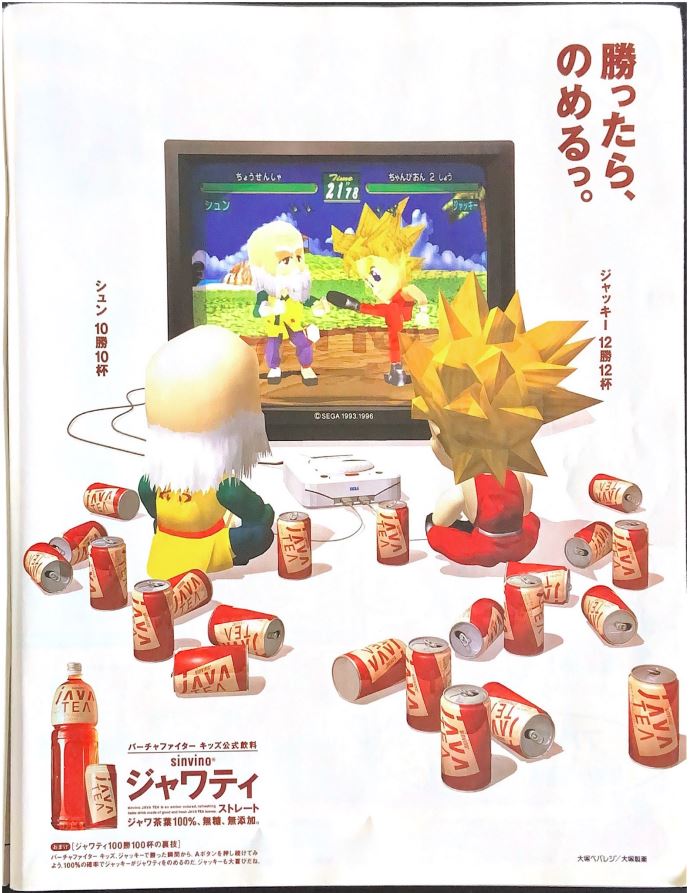
    Here is an ad for some bottled tea exclusive to Japan (at least to my knowledge, I've never seen it anywhere in the USA) along with Shun and Jacky playing more of the game. All I know is if I'm drinking that many cans of tea while and trying to win in a fighting game, I would have to piss so bad it's not even funny.